Easttown Township is excited to share the latest on the Berwyn Route 30 Complete Streets Initiative—a community-driven effort to reimagine Lancaster Avenue as a safer, more vibrant, and welcoming “main street” for all.
This initiative is not new. The vision for a more walkable, accessible, and attractive Lancaster Avenue is rooted in the Township’s Comprehensive Plan, which calls for transforming Route 30 into a “Complete Street.” This plan, adopted by the Township, recommends improvements to pedestrian and bicyclist mobility, parking, and the overall character of Berwyn’s village center.
How Was the Planning Process Structured?
The planning process for the Complete Streets Initiative is transparent, step-by-step, and designed to ensure that community needs, technical analysis, and public feedback all shape the final outcome.
The diagram below shows how the process works:
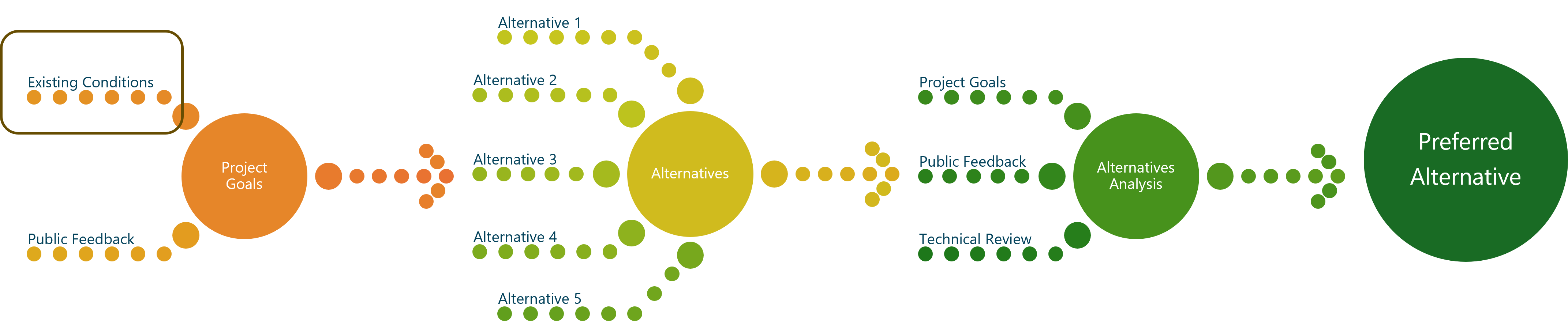
Here’s what each step means:
- Existing Conditions & Public Feedback:
The process began with a thorough review of current conditions on Lancaster Avenue—traffic, safety, sidewalks, parking, and more. At the same time, we gathered feedback from residents, businesses, and visitors about their experiences and priorities.
- Project Goals:
Using this information, the Township established clear goals for the project—such as improving safety, supporting local businesses, and creating a more walkable, vibrant main street.
- Alternatives Development:
Multiple alternatives were developed to address these goals. Each alternative represents a different approach to improving Lancaster Avenue, including changes to lane configurations and intersections.
- Alternatives Analysis:
All alternatives were carefully analyzed against the project goals, technical criteria, and additional public feedback. This included traffic modeling, safety analysis, and consideration of costs and benefits.
- Preferred Alternative:
The process will result in a “Preferred Alternative”—the solution that best meets the community’s needs and the project’s goals.
Project Overview
Lancaster Avenue is the heart of Berwyn’s business district, but today it faces challenges: speeding traffic, narrow sidewalks, confusing intersections, and limited places to gather or park. The Complete Streets Initiative builds on years of planning and community input to address these issues and unlock the corridor’s full potential as a community hub.
Learn more about the project’s background, goals, and vision in our downloadable memo: Project Background Memo
Community Engagement
In Spring 2025, Easttown Township conducted a public survey and hosted pop-up engagement events to gather input from residents, business owners, and visitors. Hundreds of people shared their experiences, concerns, and ideas for making Lancaster Avenue better.
See what we heard from the community: Survey & Engagement Summary
Project Goals
The initiative is guided by these key goals:
- Enhance safety for all users—reduce crashes and make crossings safer
- Accommodate all modes of transportation—walking, biking, driving, and transit
- Address parking needs strategically—support local businesses and access
- Foster placemaking and community identity—create inviting spaces and a sense of place
- Support economic development and business vitality
- Improve quality of life and community connectivity
What Alternatives Are Being Considered?
After extensive study and community input, the main decision is whether to maintain the existing four-lane cross section on Lancaster Avenue or to convert to a three-lane cross section (one lane each way plus a center turn lane). Each approach includes sub-options for intersection improvements and streetscape enhancements.
Category 1: Maintain the 4-Lane Cross Section
These alternatives keep two travel lanes in each direction through Berwyn, with different intersection and signal improvements at Lancaster Avenue, Old Lancaster Road, and Bridge Avenue.
- 1A. Existing Configuration
No major changes to intersections or street layout; focuses on improved signal timing and coordination.
- 1B. Add Eastbound Left Turn Lane at Bridge Avenue
Adds a dedicated left turn lane for eastbound traffic at Bridge Avenue to improve flow, but retains the four-lane cross section.
- 1C. Intersection Realignment
Realigns the intersection at Lancaster Avenue, Old Lancaster Road, and Bridge Avenue to simplify traffic movements and signal timing, while keeping four lanes.
- 1D. Realignment with Lane Adjustments
Builds on 1C by further adjusting lane configurations and adding a leading pedestrian interval for safer crossings.
Key Trade-offs for 4-Lane Options:
- Maintains current traffic capacity
- Minimal construction disruption
- Limited on-street parking
- Longer, less safe pedestrian crossings
- Fewer opportunities for placemaking, bike lanes, or wider sidewalks
Category 2: Convert to a 3-Lane Cross Section (“Road Diet”)
These alternatives reduce Lancaster Avenue to one travel lane in each direction, with a center two-way left-turn lane, creating space for on-street parking, wider sidewalks, and enhanced streetscape features.
- 2A. 3-Lane with Intersection Realignment
Realigns the intersection at Lancaster Avenue, Old Lancaster Road, and Bridge Avenue, and implements the 3-lane cross section throughout the corridor.
- 2B. 3-Lane with Roundabouts
Introduces modern roundabouts at key intersections (including Lancaster/Old Lancaster/Bridge and Midland), while maintaining the 3-lane cross section.
- 2C. 3-Lane with Signal at Old Lancaster/Bridge and Roundabout at Midland
Realigns the intersection at Lancaster Avenue, Old Lancaster Road, and Bridge Avenue, and Introduces modern roundabout at Midland and Lancaster, while maintaining the 3-lane cross section.
Key Trade-offs for 3-Lane Options:
- Improves pedestrian safety and walkability
- Adds on-street parking
- Supports placemaking and business vitality
- Allows for bike lanes or wider sidewalks
- May reduce vehicle speeds and slightly increase travel times
- Higher construction impact and cost
How Do the Options Compare?
The table below summarizes the key features and trade-offs for each alternative.
| Category & Option | Key Features | Trade-offs/Impacts |
|---|
| 1A. 4-Lane, Existing | No major changes | Maintains capacity, but limited safety/walkability |
| 1B. 4-Lane, Left Turning Lane | Adds EB left turn lane at Bridge | Slightly better flow, still limited walkability |
| 1C. 4-Lane, Realignment | Realigns intersection | Simplifies traffic, modest pedestrian benefit |
| 1D. 4-Lane, Realignment + Lane Adjustments | Adds pedestrian interval | Some safety improvement, still 4 lanes |
| 2A. 3-Lane, Realignment | 3-lane section, realigned intersection | Major safety, walkability, and placemaking gains |
| 2B. 3-Lane, Roundabouts | 3-lane section, roundabouts | Maximizes safety, flow, and placemaking |
| 2C. 3-Lane, Realighment, Roundabout | 3-lane section, realigned intersection, roundabout | Major safety, walkability, and placemaking gains |
For more information see: Alternatives Analysis Memo
What does this mean for Berwyn?
The analysis shows that the 3-lane alternatives can deliver major safety and walkability benefits without causing significant new congestion. This allows the community to consider the full range of benefits—safer crossings, more walkable spaces, and support for local businesses—while maintaining efficient traffic flow.